

Creating Content That Actually Converts: Practical Strategies for Generating Leads and Growing Clients
Content that converts does three things: grabs attention, builds trust, and nudges the right prospects toward a clear next step—usually a lead capture or a service request. This guide gives hands-on methods to research your audience, pick formats that convert, map content to buyer stages, craft persuasive CTAs, and measure ROI so you can scale client acquisition. If you’re frustrated by content that feels relevant but doesn’t deliver leads, follow this step-by-step approach that ties audience insight to content mechanics and measurable optimization. We cover buyer personas, high-converting formats like blog posts and video, CTA best practices, analytics-driven iteration, and local tactics for Florida businesses. Expect practical checklists, format comparisons, and tactics you can use right away to improve conversion-focused content marketing.
How do you learn your target audience well enough to create content that converts?
Understanding your audience means pairing qualitative insight with hard data to build models that predict preferences and behavior. Define your ideal customers and you’ll know which channels, formats, and messages are most likely to turn them into leads—because relevance lowers friction and builds trust. Start with analytics, interviews, and social listening to test assumptions, then turn those findings into content priorities that match intent and buying drivers. Below we show how to create usable buyer personas and how to translate pain points into content that prompts action—your foundation for conversion-focused content.
What are buyer personas and how do they lift content engagement?
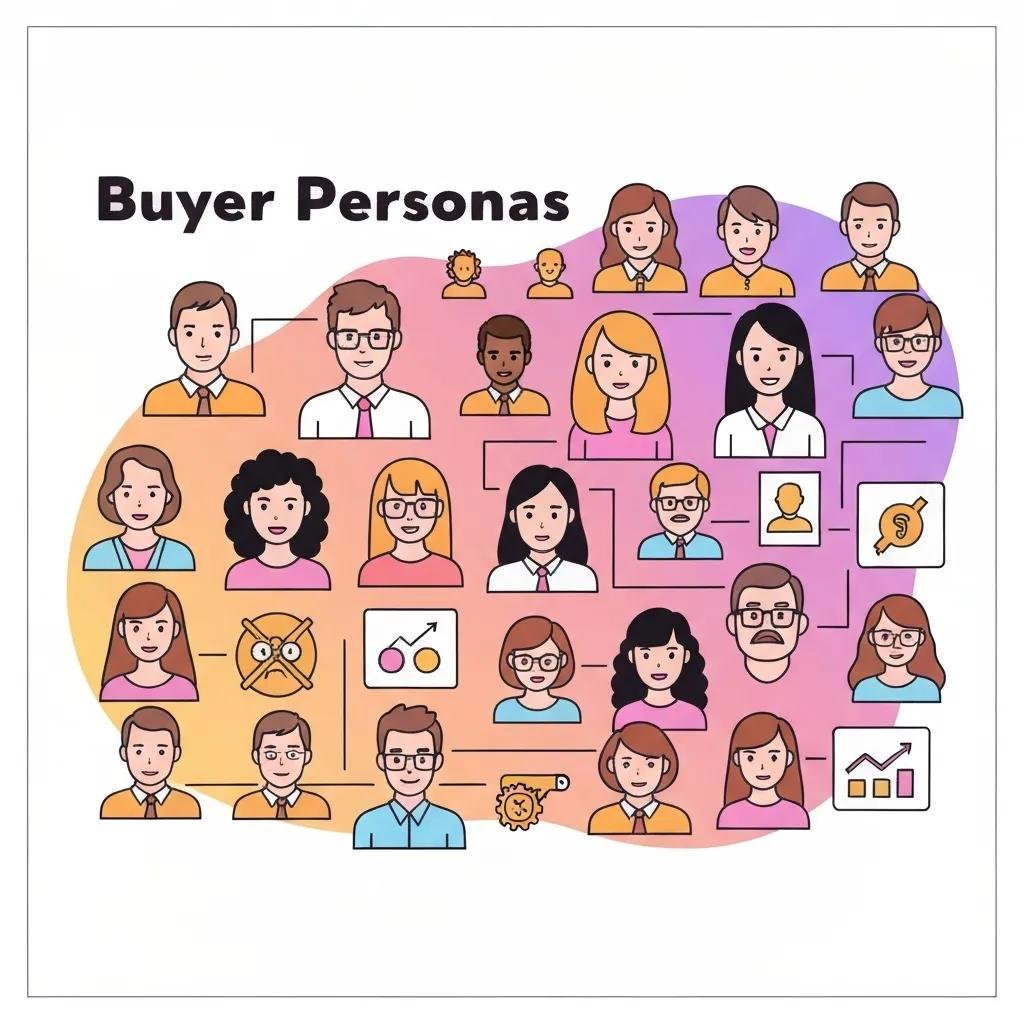
Buyer personas are semi-fictional profiles that capture the demographics, goals, pain points, motivations, and preferred channels of your core audience groups. They work because they turn raw data into clear user types you can speak to directly—choosing tone, format, and CTAs that resonate. A simple persona template covers job role, business size, primary goal, main pain point, research habits, and decision criteria; for example, an Orlando small-business owner might prioritize local referrals, transparent pricing, and fast site performance. Build personas from analytics segments, surveys, and interviews, then use them to decide whether a blog, video, or case study will best move that persona through the funnel. Clear personas boost relevance, engagement, and lead capture.
How do audience pain points shape the content you create?
Pain points define the problems your content must solve and the offers that will convert readers into leads—people act when content tackles a specific, pressing need. Map common pains—low visibility, too few leads, muddled messaging—to content responses like how-to articles, audit-based lead magnets, and comparative case studies. Use a simple three-step mapping: name the pain, pick a format that demonstrates expertise, and attach a focused CTA that resolves the issue with measurable next steps. Framing content as a useful solution (not an interruption) raises perceived value and improves both conversion rates and lead quality.
- The persona process typically follows three steps:
Collect data: Pull analytics, run surveys, and interview customers to gather behavioral and demographic signals.
Synthesize patterns: Group shared goals, challenges, and channels into 2–4 persona archetypes.
Apply personas: Match content topics, tone, and CTAs to each persona’s preferred journey.
Which content types actually drive higher lead conversion?
High-converting content matches intent, lowers perceived risk, and gives a clear next step. Blog posts, videos, infographics, case studies, and interactive lead magnets each serve a distinct conversion purpose. Different formats convert through mechanisms like SEO-driven discovery (blogs), fast trust-building (video), simplified understanding (infographics), proof of outcomes (case studies), and engagement-to-email capture (quizzes/calculators). Choose formats by funnel stage and the friction you need to remove to earn a contact. The table and sections below compare formats, explain why they work, and outline production and distribution notes.
Different content formats convert through specific mechanisms and require different investment levels.
How do blog posts and articles turn readers into leads?
Blogs convert by combining topical SEO, smart internal linking, and content upgrades that turn visitors into subscribers or prospects. Search-driven discovery brings intent you can harvest with a tightly matched offer. Tactics include targeting long-tail keywords that attract buyers, adding content upgrades (checklists, templates) to collect emails, and linking to landing pages that host conversion forms. Build pieces with clear briefs, intent-focused headlines, and a CTA hierarchy (in-content, sidebar, end-of-post). With measured promotion—social shares, email syndication, and backlink outreach—blog posts become reliable lead channels that feed nurture sequences.
- Blog-to-lead checklist:
Target intent: Pick keywords that match buyer intent.
Offer fit: Attach a lead magnet that directly solves the reader’s problem.
Conversion path: Use internal links and landing pages to smooth the path to conversion.
Apply this consistently and informational traffic becomes predictable, qualified leads over time.
Why is video marketing critical for generating leads?

Video converts because it builds trust faster, shows capability visually, and reaches audiences where they spend time—watch time and engagement are strong signals of later lead actions. Short-form clips (15–60 seconds) excel for awareness and social reach, while longer explainers and demos work in consideration and decision stages by answering deeper buyer questions. Always add clear CTAs—text overlays, end screens, pinned comments—asking viewers to download a guide, book a demo, or request an audit; track view-to-lead ratios to refine format and placement. A practical production approach: script tightly, batch-produce, and edit per platform to get the most ROI.
- Video production tips:
Script for intent: Match length and depth to the funnel stage.
Include direct CTAs: Add explicit next steps and tracking where possible.
Repurpose: Turn long videos into short social clips to extend reach.
These practices help video both engage viewers and convert them through the funnel.
How do you optimize content for each stage of the buyer’s journey?
Optimizing by journey stage means delivering the right content at the right time—awareness pieces attract, consideration content educates, and decision assets remove friction. Mapping content to stages improves conversion because it aligns message specificity and CTA strength with buyer readiness. The table below recommends content, channels, and CTAs for Awareness, Consideration, and Decision stages to make mapping practical for planning.
Use this mapping table to assign content types and CTAs by buyer-journey stage.
Once you map stages to formats, add nurture and scoring: tag behaviors (downloads, webinar attendance) to escalate offers and prioritize leads. For teams that want a structured method, Bloom Design ME’s Visibility Boost Blueprint is a tactical framework for mapping content to journey stages and prioritizing production based on expected lead lift. The Blueprint aligns SEO, email, social, and video to move prospects from awareness to decision and pairs well with an audit-driven approach. If you prefer an external review, Bloom Design ME also offers a Free Visibility Health Audit to highlight gaps and quick wins in your content-to-journey alignment.
What works best in the awareness stage?
Awareness content should be high-reach, low-commitment—topical blog posts, short social videos, infographics, and quizzes that introduce problems and build familiarity without asking much from the audience. The key mechanism is discoverability: search optimization, platform-native distribution, and shareability increase reach and attract lower-intent prospects. Measure success with impressions, organic traffic, and social engagement, then retarget engaged users with consideration-stage offers. End awareness pieces with a low-friction CTA—subscribe, download a short checklist, or take a quick assessment—to capture baseline interest and enable nurturing.
How do you craft consideration and decision content that converts?
Consideration content should educate and compare options—webinars, deep guides, case studies, and calculators—while decision assets remove friction with proof: case studies, demos, trials, or audits that show measurable outcomes. The conversion mechanism is evidence: clear results and risk reduction make prospects comfortable taking the next step. Build landing pages for these assets with bold CTAs, social proof (metrics and outcomes), and simple forms that collect only essential qualification info. Sequence offers naturally—awareness → gated guide → webinar → case-study-driven demo—to increase commitment and improve lead quality for sales outreach.
What are the best practices for designing effective calls to action?
Strong CTAs pair clarity, value, and urgency so users instantly understand the next step and the benefit of taking it. They’re persuasion endpoints that turn engagement into measurable leads. CTA performance depends on copy (action + benefit), design (contrast, size, whitespace), placement (in-content, end-of-article, exit-intent), and methodical testing. Start tests with headline and CTA copy, then iterate color and placement, and finally test offer variations to find what actually moves the needle. Below we offer copy formulas, placement priorities, and practical CTA examples to try.
The Power of a Strong Call-to-Action for Lead Generation and Conversions
A clear, well-timed call-to-action is what turns a visitor into a customer. It’s more than a button—it’s a strategic prompt that guides users to the next step. Whether you want newsletter signups, guide downloads, or demo requests, a focused CTA can noticeably lift lead generation. This piece explains why CTAs matter and how to optimize them for better conversion results.
Below are proven CTA copy formulas and examples you can adapt for sites, emails, and social posts.
- Action + Value: "Download the SEO checklist" — clear action and reward.
- Action + Timeframe: "Get a 15-minute audit" — lowers perceived time cost.
- Action + Social proof: "Join 500 Florida businesses who saw more leads" — builds trust.
Use each CTA type where the user’s friction level matches the offer.
We also recommend testing headline + CTA pairs. Examples to trial include:
- Headline: "Increase qualified leads in 90 days" — CTA: "Request a Free Visibility Health Audit"
- Headline: "Local SEO that brings traffic" — CTA: "Book a Consultation"
- Headline: "See a 2–5x client growth playbook" — CTA: "Request a Quote"
How do you write CTAs that people actually click?
Top CTAs follow a simple formula: a clear verb, an obvious benefit, and a low-friction promise. Short, direct phrases work best—examples: "Download the checklist," "Schedule a 15-minute audit," "See case-study results." Visually, CTAs should contrast, use whitespace to stand out, and appear where they make sense—both above and below the fold when appropriate. Test variations in button copy and supporting microcopy while tracking conversion quality. Let measured lift guide your final design choices, not opinion.
Where should CTAs live for maximum impact?
CTA placement should match user intent: put primary CTAs above the fold on high-intent landing pages, use in-content CTAs for educational blog posts, and rely on end-screens for videos or long guides—timing matters for readiness. Use a placement priority: landing pages get a primary CTA and minimal distractions, blogs get contextual CTAs and content upgrades, videos use overlays and end screens, and exit-intent or slide-ins can recover abandoning visitors. Make sure CTAs are mobile-friendly, fast to load, and tracked with proper event tags so A/B tests are valid. Move CTAs based on data, focusing on qualified leads over raw clicks.
- CTA placement priority matrix:
Landing pages: Primary CTA near the top, supporting CTAs in-body.
Blog posts: In-content CTA + end-of-post offer + sidebar upgrade.
Video: Inline overlay, pinned CTA in the description, and end screen.
How do you measure content performance and improve it?
Measuring performance means defining the right KPIs, wiring analytics correctly, and setting a regular cadence for iteration so decisions are evidence-driven. Core KPIs for content-led lead gen include organic traffic, conversion rate (leads ÷ visitors), lead quality (MQL/SQL counts), engagement (time on page, watch time), and revenue attribution. Use GA4, Search Console, and SEO tools to gather signals, and map each content type to the KPIs that matter most for its role in the funnel. The table below links content types to their most useful metrics to clarify measurement and optimization.
Mapping content to KPIs keeps your focus on the outcomes that drive conversion gains.
After measuring, follow an iterative improvement loop: flag underperforming pages, run experiments (headlines, CTAs, format), update and re-promote, then reassess. A four-step analytics-to-action workflow works well: collect data → diagnose drop-offs → design an experiment → implement and measure. Repeat the cycle to steadily improve conversion efficiency.
Which KPIs show lead conversion success?
Key conversion metrics include conversion rate (leads ÷ visitors), lead-to-customer rate, MQL and SQL counts, channel-attributed lead volume, and lifetime value for content-sourced leads. Conversion rate is foundational—track it across pages to see which content captures leads efficiently. Combine conversion with quality signals—time on page, pages per session, and gated-asset engagement—to separate high-volume from high-quality sources. Benchmarks differ by industry, but using both volume and quality metrics helps prioritize where to invest.
How should analytics shape content strategy refinement?
Analytics reveal which topics and formats attract attention and which actually convert, letting you prioritize updates, repurposing, and new content. Use data to expand top-performing pages and consolidate or repurpose low-performing ones; for example, turn a low-traffic but high-converting page into a campaign or test new CTAs on high-traffic underperformers. Prioritize actions that offer the biggest expected lead lift per hour: technical SEO fixes, CTA tweaks, or repackaging long-form content into interactive assets. Track experiments over time to build a continuous improvement feedback loop that raises content ROI and lead quality.
- Analytics-to-action workflow:
Collect: Gather traffic, engagement, and conversion data.
Diagnose: Find drop-off points and content gaps.
Experiment: Test CTA copy, design, and distribution.
Scale: Roll out winners and reallocate resources.
How does Bloom Design ME’s local expertise improve content that converts in Florida?
Bloom Design ME combines local market knowledge with services tuned to lead generation—Marketing Plans, Branding, Website Design, SEO, Email, Social Media, Paid Ads, Reputation Management, and Video Marketing—to build end-to-end content-to-conversion programs for Florida businesses. Local expertise matters because city-level search patterns, seasonality, and community channels (events, local news, niche directories) shape how audiences discover and trust vendors. Tailoring messages to city specifics improves relevance and lead quality. Our approach focuses on measurable client-acquisition outcomes and includes a Free Visibility Health Audit to surface high-impact improvements for local visibility, making optimization actionable across Florida markets.
Why use tailored content strategies for Florida businesses?
Local strategies factor in city search behaviors, seasonal demand (tourism, events), and community networks, which affect keywords, topic choice, and timing. For example, Orlando content might lean into event- and tourism-related searches, while Tampa content could highlight B2B partnerships or nonprofit initiatives. Localized metadata, city-specific case studies, and community partnerships increase SERP relevance and trust with nearby prospects. These local signals improve discoverability and conversion by showing you understand the prospect’s context and needs.
Customer Journey Mapping for Content-Rich Branding and Engagement
This study shows how customer journey mapping supports content-rich branding, breaking a buyer’s path into prepurchase, purchase, and postpurchase phases. Each phase lists key touchpoints—both firm- and customer-initiated—and highlights how relevant content can create more positive interactions. Customer journey analysis is a useful tool for shaping content that guides prospects through each phase.
How do case studies show Bloom Design ME’s lead-conversion results?
Good case studies follow a clear structure—challenge, strategy, metrics, outcome—and that format shows how content strategy and technical work move the needle on leads. A concise snapshot outlines the initial visibility gap, the content and SEO tactics used (blog series, testimonial videos, targeted paid campaigns), and the resulting metrics—traffic, leads, and conversion gains. If you want a tailored assessment, book a consultation or request a quote; we position the Free Visibility Health Audit as a no-cost first step to quantify opportunity and map an implementation plan. That audit-driven path helps move prospects from evaluation to a scoped program designed to scale client acquisition.
- Local expertise benefits summary:
Improved relevance: City-specific content boosts local search performance.
Seasonal targeting: Content aligned with events captures time-sensitive demand.
Community trust: Local case studies and partnerships increase conversion.
Frequently Asked Questions
What role does SEO play in lead generation through content marketing?
SEO is foundational for lead generation—it makes your content discoverable by people actively searching for solutions. Optimizing for relevant keywords, meta tags, and authoritative backlinks brings the right visitors at the right time, increasing the chance of conversion. Ongoing SEO work sustains and improves rankings, keeping lead flow steady over time.
How can social media be used to boost lead generation?
Social media helps you engage directly with your audience: share helpful content, run targeted ads, and join conversations to build awareness and trust. Use social analytics to see what resonates, then double down on top formats. Add clear CTAs in posts to drive followers to landing pages or lead forms and convert engagement into leads.
What common mistakes should be avoided in content marketing for lead generation?
Common missteps include skipping audience research, ignoring SEO, and leaving out clear CTAs. Producing content without a strategy yields inconsistent messaging and weak engagement. Overly promotional content also puts readers off. Focus on useful, relevant content that addresses real pain points and always include a clear next step for conversion.
How important is mobile optimization for lead-generating content?
Mobile optimization is essential—most traffic now comes from phones. If content isn’t responsive or loads slowly, users bounce and leads are lost. Make pages fast, responsive, and easy to navigate on mobile. Google favors mobile-friendly sites, so optimization also helps your visibility.
Which metrics should be tracked to evaluate content effectiveness for lead generation?
Track conversion rate, organic traffic, and engagement metrics (time on page, bounce rate) to evaluate effectiveness. Conversion rate shows how well content turns visitors into leads; organic traffic measures SEO reach; engagement shows relevance. Also monitor lead quality through MQLs and SQLs to understand whether leads are valuable.
How can businesses keep their content relevant over time?
Update content regularly to reflect new data, trends, and audience needs. Run periodic content audits to spot outdated pages and opportunities. Use audience feedback and analytics to guide updates. Produce a mix of evergreen content and timely pieces tied to current events so your site continues to attract and convert visitors.