

Creating Email Campaigns That Convert: Practical Strategies to Improve Opens, Clicks, and Revenue
Email works when message, measurement, and momentum line up. This guide walks you through planning conversion-focused campaigns, writing emails that drive action, building nurturing sequences, running reliable A/B tests, tracking the right KPIs, and scaling personalization so your opens and clicks turn into real revenue. Many small and mid-size businesses struggle because they lack segmentation, automation, or a testing framework — here you’ll find step-by-step workflows and practical templates to fix that. Read on to learn goal-setting, audience segmentation, subject-line and mobile design best practices, welcome and re‑engagement flows, A/B test plans, KPI trackers, and personalization tactics tailored for SMBs and mission-driven organizations.
How do you plan an email campaign to maximize conversions?
Start by naming the conversion you want, mapping the customer journey, and deciding how you’ll measure success. Planning works when everything aligns: goals shape segments, segments shape messaging, and messaging plus cadence nudges action. A clear plan cuts wasted sends and raises conversion because each message has a purpose. Below we unpack goal-setting, audience segmentation, and a compact planning checklist you can use right away.
What goals should you define for an email campaign?
Pick a single primary conversion goal (for example, booking consultations) and two supporting goals like lead quality or retention. Attach KPIs — conversion rate, revenue per recipient, lead-to-client conversion — to each goal. Use SMART targets (specific, measurable, achievable, relevant, time‑bound) for weekly and monthly checkpoints and sync them to sales or fundraising timelines. Clear goals make attribution easier and guide your segmentation and cadence choices.
How does audience segmentation improve relevance?
Segmentation groups subscribers by demographics, behavior, or lifecycle stage so your messages meet intent. Triggers might include past purchases, browsing behavior, sign-up source, or engagement recency; these create groups like welcome series, re-engagement lists, and transactional audiences that need tailored copy. A simple four-step segmentation workflow: identify business goals, map available data, define segment rules, and run test sends to measure lift. Good segmentation raises open and conversion rates by sending contextually relevant emails that respect subscriber intent.
Research shows subject-line personalization can dramatically lift opens — one study reported a 50.07% open rate when emails included the recipient’s first and last name.
Personalizing Email Subject Lines for Higher Open Rates
1. E-mailing is an effective and close form of communication between company and customers. However, due to the massive number of e-mails sent by almost all brands, companies have faced recently low open rates on their e-mail marketing campaigns. It is important to understand the most effective techniques that capitalize e-mail marketing. Considering the importance of customization in direct marketing, this study explores the impact of e-mail marketing customization in subject line. Four A/B tests were used regarding the subject line of a specific brand campaign. Four tactics were used: include the first name of the reader to the subject line; include the first and last name of the reader; add emojis to the subject line; opting for a subject line in form of a question; and lastly, the default subject line without any of the previous variables. The study considered a sample of 102.574 individuals of a company’s e-mail marketing database. The variables of subject line were analyzed according to the layout and segmentation, as well as open rates and clicks. The results showed that e-mails containing the variable with the first and last name had the highest open rate, specifically 50,07%. Although A/B tests should consider the specific database of the company under analysis and generalization should be seen with caution, the study enhances the importance of e-mail personalization in the subject line.
Subject line personalization techniques and their influence in the E-mail marketing open rate, B Casais, 2022
Use this short checklist to plan conversion-focused campaigns — it doubles as a featured snippet for quick reference.
- Define one measurable conversion goal and supporting KPIs tied to revenue or leads.
- Map the customer journey from awareness to conversion and mark segment-specific touchpoints.
- Create a content calendar listing message intent, CTA, and send cadence by segment.
- Confirm technical setup: ESP, DKIM/SPF, list hygiene, and deliverability monitoring.
- Set test plans and a reporting cadence so you can validate improvements and iterate.
These steps move you from strategy to execution and lead into the content and design tactics below.
What are the best practices for writing high-converting email content?

High-converting emails combine a strong subject line, a reinforcing preheader, concise body copy, a single clear CTA, and mobile-first design to reduce friction. The idea is clarity: every element answers “what’s in it for me?” and “what do I do next?” When subject, copy, layout and timing match the segment, you’ll see better open-to-click and click-to-conversion rates. Below are practical tips for subject lines and mobile design, plus a quick reference table of email elements and best practices.
How do you write subject lines that open more inboxes?
Good subject lines promise value, create curiosity, or add urgency — and they must match the preheader and the email’s content. Try formulas like Benefit + Timeframe, Curiosity + Tease, or Personalization + Offer. Keep subject lines under ~50 characters for mobile and test variations to learn what your audience prefers. Don’t mislead — that hurts trust and deliverability. Match tone to the segment (educational for new subscribers, direct for cart abandoners) and let winning variants feed your test backlog.
Why is mobile-responsive design essential?
Most opens happen on mobile. If your email renders poorly, conversion drops. Use a single-column layout, thumb-friendly CTAs, optimized images, and short text blocks so the main CTA appears without extra scrolling. Compress images, use scalable type, and make buttons at least 44px tall for touch accuracy. A smooth mobile experience raises CTR and conversions and informs how you structure nurture flows after a click.
Different email elements need focused best practices to boost opens and clicks. The table below summarizes recommended approaches and quick examples you can apply immediately.
Intro: A compact comparison of core email elements, what to focus on, and a practical example for each.
Use this as a checklist when building templates so your emails remain consistent and conversion-oriented.
How can nurturing sequences turn leads into clients?
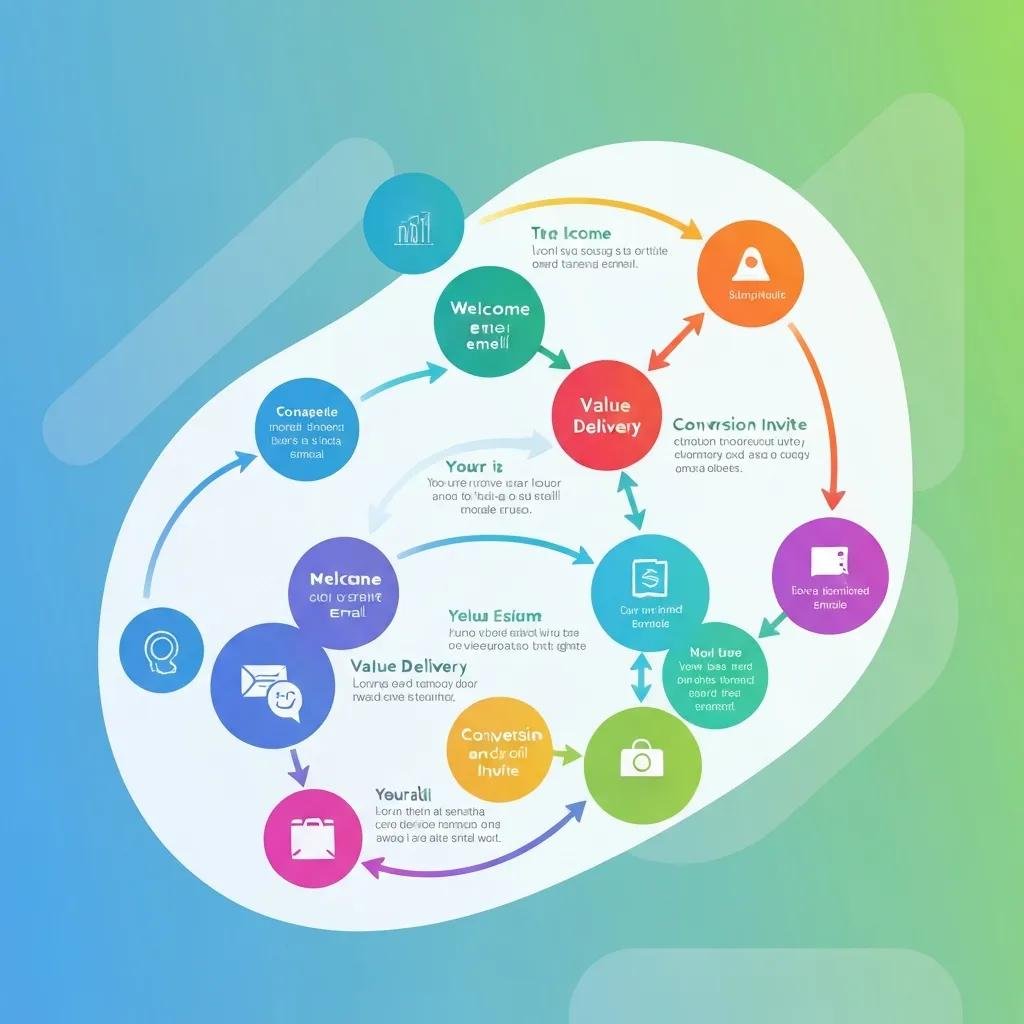
Nurture sequences move subscribers from awareness to action by delivering staged value that builds trust and reduces buying friction. The principle is progressive qualification: teach, observe behavior, then present the right offer when a lead shows intent. Clear sequence architecture creates more sales-ready leads and shortens sales cycles because every email has a measured intent. Below we cover welcome-series structure and automation tactics using behavioral triggers and lead scoring.
How do you build an effective welcome series?
A welcome series introduces your value, delivers immediate help, and guides recipients toward a conversion across multiple touches. A typical flow is 3–5 emails: an immediate welcome that sets expectations, a value email with a guide or resource, a social-proof message that deepens benefits, and a conversion-focused invite with urgency or an incentive. Send the first message instantly, follow up in 2–4 days, and space later emails based on engagement to avoid unsubscribes. Track open rate, CTR, and conversions per email to refine the sequence and inform segmentation rules.
How do automations increase sales-ready leads?
Automation raises lead quality by applying simple lead scoring, behavior-triggered sends, and content mapped to intent so only engaged prospects see conversion offers. Use straightforward scores (for example, +10 for a resource download, +20 for a pricing-page visit) and trigger workflows when thresholds are hit. This gives sales warmer leads with a clear interaction history, reduces manual follow-up, and improves conversion by delivering the right message at the right moment. Automations also feed test and measurement programs so you can validate impact.
Intro: Here’s a compact, practical welcome sequence that fits many SMB use cases.
- Welcome & Expectations: Immediate thank-you that sets frequency expectations and links a quick resource.
- Value Delivery: Day 2–3 email with actionable content and a soft CTA to engage.
- Conversion Invite: Day 5–7 message with a focused offer, testimonial, or limited-time incentive.
Summary: This three-step flow builds trust, measures engagement, and converts when leads show intent — a model that pairs well with segmentation and testing.
For implementation, Bloom Design ME uses a Visibility Boost Blueprint that follows these sequence principles: clear goals, audience mapping, content calendar, automation setup, and iterative testing. That five-step roadmap turns planning templates into ready-to-run automations for Florida-based SMBs. If you want a second opinion on your sequences, book a consultation to get prioritized test recommendations.
Which conversion-rate tactics boost email performance?
Conversion rate optimization for email is about prioritized tests, clear hypotheses, and reliable KPI tracking so you can identify lifts and scale winners. The process is iterative: run controlled A/B tests, measure outcomes, and roll winners into future sends. Test subject lines, CTA copy and color, layout changes, and personalization variants. The sections below explain A/B basics and CTA optimization and include a planning table to structure experiments.
How does A/B testing improve results?
A/B testing isolates one variable, measures its effect on a chosen KPI, and replaces guesswork with evidence. A good test needs a clear hypothesis, sufficient sample size, and a defined success metric (open rate, CTR, or conversion). Avoid multi-variable tests unless you have strong traffic — otherwise results won’t be reliable. Start with subject lines, CTA copy, and hero-image presence; prioritize tests by expected impact and ease of execution.
How do you optimize CTAs in email?
Good CTAs are clear, benefit-focused, and easy to act on. Use action microcopy (e.g., “Reserve my spot” vs. “Learn more”), high-contrast buttons that meet accessibility guidelines, and place the primary CTA early with one supportive CTA lower in long messages. On mobile, make CTAs tappable and visible above the fold; on desktop, test both buttons and linked text. Track CTR and conversion rate and iterate based on what performs best.
Intro: Use this A/B testing plan to map experiments, compare variants, and record the KPI to watch.
Summary: A structured test plan removes guesswork and ensures experiments produce actionable insights that feed into segmentation, content, and automation.
Prioritize tests like this:
- Start with high-impact, low-effort wins (subject lines, CTA copy).
- Move to medium-effort layout and design tests once messaging is stable.
- Reserve multivariate or advanced personalization tests for when you have reliable traffic and measurement.
This order delivers early wins and builds a sustainable optimization program.
How should you measure email campaign performance?
Track the right KPIs, set benchmarks, and attribute conversions within a regular reporting cadence so data informs ongoing optimization. Match metrics to goals: deliverability and open rate show list health, CTR and conversion rate show message effectiveness, and revenue per email shows business impact. Accurate measurement points you to whether to focus on list hygiene, creative, or targeting. The next sections define key KPIs and audit steps.
Which KPIs should you track?
Keep a small set of core KPIs tied to campaign goals: deliverability, open rate, click-through rate (CTR), conversion rate, revenue per email, and unsubscribe rate. Use consistent formulas (for example, CTR = clicks / delivered) and compare trends rather than single sends. Benchmarks depend on industry and list quality, so focus on improving your own trendlines through testing and segmentation. The table below gives definitions, formulas, and target benchmarks for SMB-focused programs.
Intro: A KPI cheat sheet with definitions, calculation tips, and suggested targets for SMB campaigns.
Summary: Use these KPIs to diagnose list health, message relevance, and conversion effectiveness. Track them in a dashboard and tie them back to campaign goals.
How can ongoing audits and optimization improve results?
Regular audits keep deliverability healthy, content fresh, and segmentation accurate so performance improves instead of drifting. An audit should check authentication (DKIM/SPF), list hygiene (remove hard bounces), engagement-based pruning, template rendering across clients, and a review of test outcomes to apply learnings. Do light monthly checks and deeper quarterly reviews to refresh calendars, offers, and segmentation logic. That cadence makes improvements compound and prepares you to scale personalization.
Intro: A short audit checklist to keep systems and content healthy.
- Authentication & Deliverability: Confirm sending domains and monitor spam complaints.
- List Health: Remove hard bounces and suppress inactive segments.
- Template & Rendering: Test across major email clients and devices.
- Testing & Reporting: Document results and roll winners into future sends.
Summary: Regular audits lower deliverability risk and protect conversion rates by keeping the technical and creative foundation solid.
Why does personalization matter for email conversion?
Personalization increases conversion by making messages more relevant to an individual’s needs, which raises engagement and reduces friction to act. Use behavioral signals and profile fields to deliver dynamic content that fits the recipient’s context. Personalization can be simple merge tags, dynamic content blocks, or fully tailored recommendations — scaling it requires mapping segments to content, data governance, and privacy safeguards. The following sections cover advanced personalization approaches and how segmentation enables 1:1 relevance.
How do you personalize beyond a first name?
Go beyond names by using behavior, purchase history, and location to tailor offers, content, and imagery. Techniques include dynamic product or resource recommendations, city-specific offers, and behavioral triggers tied to recent site activity. Use dynamic blocks for mid-sized segments and reserve one-to-one personalization for your highest-value audiences. Keep CRM and ESP data synced to avoid mismatches, respect privacy, and always include clear unsubscribe options. Applied correctly, these tactics boost relevance and conversion.
Effective email programs use staged personalization that tracks behavior to tailor subject lines and content, improving opens and clicks.
Improving Email Marketing Success with Personalization and Segmentation
1. Email marketing provides one of the best methods for direct communication with consumers. However, the success rate of an e-mail marketing campaign is often low because of its generic content and inadequate segmentation of customers. This paper aims to showcase the application of a two-step personalization process to improve effective open and click rates for email marketing campaigns. Consumer behaviour is monitored over a period of time in terms of email opens and click pattern. This behaviour is stream-lined into keywords sorted in order of user preference. The keywords are updated at regular intervals to account for behavioural changes in user preference. While sending the email, keywords relevant to the campaign are picked individually for each user. These keywords are used to form attractive subject lines using probabilistic language models such as noisy channel model (Mark and Charniak, Proceeedings of the 42nd annual meeting on association for computational linguistics,2004) and hidden Markov model (Lawrence and Juang, Fundamentals of speech recognition,1993).
Improving email marketing campaign success rate using personalization, G Singh, 2018
Bloom Design ME builds personalization into Email Marketing Services by mapping segment tiers to content blocks and using a phased approach: broad segments, rule-based personalization, then targeted dynamic recommendations. For Florida-based SMBs we emphasize local relevance and measurable outcomes. If you need a privacy-compliant personalization plan, request a consultation or a Free Email Marketing Health Audit to uncover quick wins and prioritized next steps.
What role does list segmentation play in personalization?
Segmentation is the foundation for scalable personalization. Group subscribers into tiers where the same dynamic rules apply — from broad (region) to narrow (recent purchaser) — and assign templates and rules to each tier. This “segments-to-blocks” mapping reduces irrelevant sends and increases conversion because each template serves a defined audience. Start with three tiers (new, engaged, inactive) and add granularity as data and capacity grow.
Intro: Practical personalization tactics you can roll out incrementally.
- Behavioral Blocks: Surface recent products or resources based on browsing history.
- Location-Specific Offers: Tailor messaging to city- or region-level events and availability.
- Lifecycle Messages: Change content based on subscriber tenure and past interactions.
Summary: Combine segmentation with progressive personalization to drive measurable lifts while keeping implementation manageable.
Ready to improve conversions? Bloom Design ME helps small and mid-size businesses and mission-driven organizations across Florida with a Visibility Boost Blueprint — a five-step process that links planning, content, automation, testing, and measurement into repeatable campaigns. If you want an expert review of your program, book a consultation or request a Free Email Marketing Health Audit to surface testable, prioritized improvements that increase conversions and ROI.
Frequently Asked Questions
What common mistakes should I avoid in email marketing?
Common missteps are skipping segmentation, relying only on first-name personalization, and not testing variants. Other frequent errors: ignoring mobile rendering, emailing too often (which annoys subscribers), emailing too rarely (which hurts brand recall), and not tracking KPIs. Fixing these areas delivers clearer wins than chasing new tools or flashy creative.
How often should I email my subscribers?
There’s no one-size-fits-all cadence. As a baseline, send at least once a month to stay top of mind; weekly or bi-weekly can work if your content consistently adds value. Let engagement metrics guide you: if opens and clicks fall, test lowering frequency or refreshing content. Quality always beats quantity.
Which tools can automate my email marketing?
Popular platforms include Mailchimp, HubSpot, and ActiveCampaign. They all support workflows, segmentation, and performance tracking, plus behavioral triggers and A/B testing. Choose a tool that integrates with your CRM and meets your automation and reporting needs.
How do I improve open rates?
Improve opens by tightening subject lines, using relevant personalization, and segmenting by interest or behavior. Test send times and subject-line formats, and make sure your sender name is recognizable. Over time, use test results to build subject-line templates that work for your audience.
Why is A/B testing important?
A/B testing replaces guesswork with data. Test one variable at a time (subject line, CTA text, layout) with a clear hypothesis and metric. Regular testing leads to steady gains in open rates, CTRs, and conversions and creates a repeatable improvement process.
How do I stay GDPR-compliant?
Obtain explicit consent before sending marketing emails, explain how you’ll use data, and offer an easy unsubscribe option in every message. Keep records of consent, secure your subscriber data, and regularly audit lists to remove inactive or unconsented contacts. Transparency builds trust and keeps you compliant.